Toward an Extitutional People
or, Why we are not down to hang
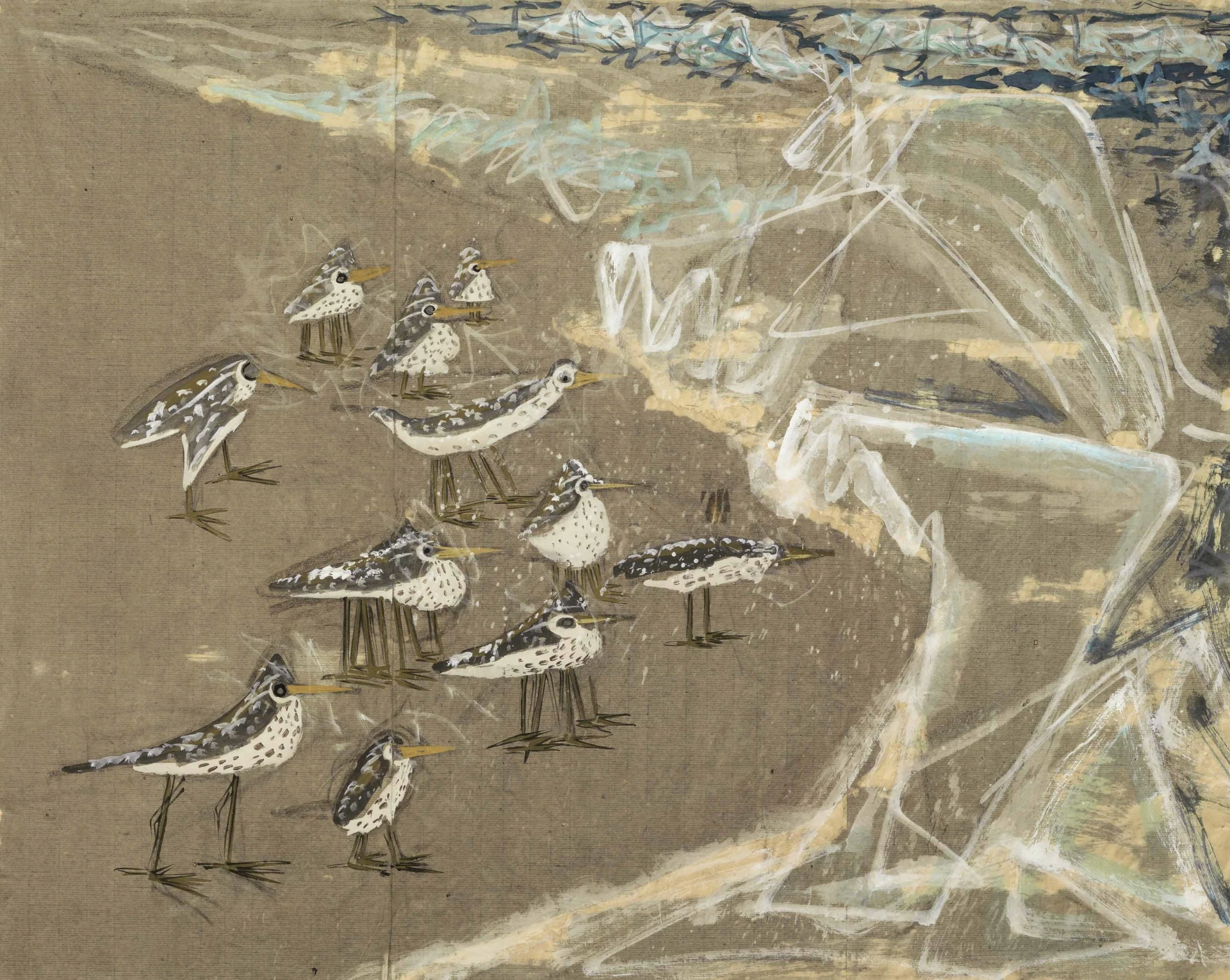
Morris Graves, Shore Birds
No visitors today, tomorrow, or the day after.
- Sign outside the ranch of Morris Graves
Let us watch him with reverence as he sets side by side the burning gems, and smoothes with soft sculpture the jasper pillars, that are to reflect a ceaseless sunshine, and rise into a cloudless sky: but not with less reverence let us stand by him, when, with rough strength and hurried stroke, he smites an uncouth animation out of the rocks which he has torn from among the moss of the moorland, and heaves into the darkened air the pile of iron buttress and rugged wall, instinct with work of an imagination as wild and wayward as the northern sea; creations of ungainly shape and rigid limb, but full of wolfish life; fierce as the winds that beat, and changeful as the clouds that shade them.
- John Ruskin
For the past three or four months, a group of us in the decentralized space have been meeting weekly to talk about extitutional theory.[1] Primavera De Filippi and Jessy Kate Schingler broke ground in 2021 by formalizing the theory of extitutionality; Amber Case’s wonderful Cyborg Encyclopedia defines it as “a framework for analyzing the latent interpersonal relationships and social dynamics that shape and animate formal institutions.”
The term has incubated in the p2p and dweb online and conference circuit, as often as not by the superficial impressions of those who like the name but have no interest in reading the literature. Our group’s attempts to reconsolidate the canon have had to reckon with this as it were “extitutional life” of extitutional theory. The insight of that reckoning may be this: while the proposed framework of extitutional theory was largely descriptive, there is an appetite out there for an elaboration of extitutionality along the vectors of antagonism, experimental organizing, and refusal of the toxic elements of what I would call administrative, or perhaps Scottian, “institutionality.”
What are the bodies already involved in extitutional organization and production, and can there be a mobilization of them against the (escalating) ineffectuality, complacency, cruelty, sociopathy and narcissism of institutions? What is an extitutional prescription?
At first glance this incitement inevitably leads to gestures of vague horizontalism - I dunno, Burning Man? What if we all just chilled? No bosses? Worlds are conjured of harmony in free discourse, raw feeling and communication beyond of the artificiality and insincerity of the office. What if we could get a big group of people together and, just, like, live in the flow?
After five years of thinking about and experimenting with extitutionality, I’m here to say that I have zero desire to hang out or be in the flow together. I don’t want to go to your party. I am interested neither in aimless delights, shared emotions nor emergent meaning within a large group of strangers. Talk to my friend and frequent co-organizer Christy Holland and her words will be even harsher. We are not down.
The Individual is a Floating Institution
Individuals (like money) are among institutionality’s most pernicious and portable innovations. I don’t mean humans, I mean individuals. Trojan horses filled with viral energies of enclosure, these carriers will inevitably have all the ingredients for what Graeber called the “dead zone” of institutionality. Leaders and followers, they are flattered easily, they are enraged more easily (the more individuals you get together the more this is compounded); they have ideas, or worse: opinions. Anyone with a group of friends larger than five knows it, this terrible thirdness: each creature may be wonderful in themselves, but the byproduct of their social collusion is absolutely cursed.
The patron saint of extitutionality Gilles Deleuze once said “the people are not here, or not yet . . . the people are missing.” I am here to say that an extitutional people won’t be found in environments of direct discursive collaboration or communication, places where ideas, opinions, emotions dwell. All that will be found there, in the reinforcements and control vectors of the institutional subject, are persons, individuals.
An extitutional people has always been conjured, and will continue to be found, in the recess of compulsory individuality that is craft, labor. If the institutionalized individual exists (as Dion Fortune argues) on a level of discursive consciousness that is only one fragment of the complex of a body, it is in the lower channels that the body finds escape. In attentive and patient engagement with the material world, on its own terms, an extitutional people discovers a space of consciousness beneath subjectivization, an extitutional continuum.
Draw a map: how far away is freedom? 10,000 hours.
Three Elements of an Extitutional People
The first feature of an extitutional people is that they are integrated by a craft with empirical stakes. They have to experiment, because the materiality of the world (whether that be stone, paint, word, code, maths) pushes back at them. The reciprocity between their imagination and the world as it is builds an agreement between the two that is like a channel of discourse with the outside. While others are fighting, romancing, opining, engaging the world of individuals, these dissidents are heads down, hearing the broadcast of the world, working it and finding the code and stone ‘laden with singularities.’
The second feature of an extitutional people is that their labor is free. This means their work is enlivening and aligned with their inner nature, what Spinoza might call their conatus. This people may get paid, but they would do the work for free. Having arrived through ordeal at a craft done out of love and up against empirical stakes, an extitutional people tends toward not only their freedom, but freedom as such. They love not only their creativity, but creativity as such. Because of this, they tend to adopt principles that benefit not just their own freedom and creativity, but the freedom and creativity of those they encounter.[2]
This gives way to the third feature of an extitutional people, characteristic of all the great eruptions of free and creative practice of the 20th century (hip hop, psychedelia, bdsm, free party movement): an extitutional people discovers or creates a stigmergic medium. This is what allows for creative exchange and reciprocity under free conditions and it is, on close examination, the essence of life without institutions. (In other work we have emphasized the liberating role of open protocolization; the stigmergic process is a generalization of that code to multiple channels of cognition.) The dance floor, the internet, the urban space, language itself. An extitutional people appears under a hoodie at night, faceless in the umbra; they come and go in silence, but when they leave, the writing is on the wall.
Wittgenstein’s famous dictum “there is no private language” can be abstracted to extitutional production itself: the free labor of an extitutional people is networked because the insight of an ordeal of freedom is in accord with reciprocity and love of the world - even when that love means hatred for the human, the individual, the enclosure it represents[3] The hermit can’t help but inter-participate: flight from the world of direct communication is cradled in the arms of the medium.
Concluding for now: A people is extitutional to the extent that they have undergone an ordeal of labor, such that their labor is empirical (1), free (2), is, by virtue of or determination by (1) & (2), engaging a stigmergic medium (3). Be it a Lee Scratch Perry, a Kathy Acker or a Richard Stallman, the triad maintains, the prolix generosity of the work like a key to the autonomy of the labor.
Looking forward, it’s my hope that these three features of a people can clarify the project of an extitutional antagonism, and even the subversive figure of the extitution itself. (Though for that, we may have to go meta.)
More soon. In the meantime, if you are interested in a foundational document of free labor, I recommend the source of the epigraph above, Ruskin’s The Nature of the Gothic.
Notes
[1] This pattern was instigated by friend and open source advocate Kevin Owocki, whose work you should check out.
[2] I outline these principles in 2026: The Rise of the Protocol Underground; I’ve often thought that these values could be read as the expressive intent of some chthonic intelligence, emergent from the social realm but alien to it, falling into wells of computational efficiency as it probes a latent space far beyond the eyes of an institutional science.
[3] Especially in the case of those hermits who find love of the world in their solitude; consider the wild tentacular visions of Hildegard von Bingen, an anchoress hermit for 30 years, or Morris Graves, who could draw a bird experiencing light in the midst of 35 years of planned solitude.